 |
Commissioner for Consumer Affairs, Food and Civil Supplies discusses the positive changes he brought about during his stint.
From bringing in IT interventions in the civil supplies department and plugging leaks in the distribution of fair price commodities to the massive changes in the consumer affairs landscape, Consumer Affairs, Food and Civil Supplies Commissioner C.V. Anand’s initiatives have increased efficiency while saving on cost. And as his stint draws to a close, Mr. Anand, in a free-wheeling interview, talks about good governance, the age of consumer activism and what the government should do to be more consumer-friendly.
Excerpts:
How has IT helped to plug leaks in the department?
Information Technology has helped reduce the scope of corruption to a great extent. For a long time, officers had been colluding with rice millers and Fair Price Shops owners. For example, there was delay in farmers getting paid for paddy and it even went up to 30 days to 60 days. The Minimum Support Price of around Rs 1,400 was not given fully. And when the cheques came, they had to add ‘weight’ (bribe officials) to get them. In consultation with the Centre for Good Governance, IT initiatives are firmly in place and payments are upfront. Even in remotest areas, payments are getting credited in the farmer’s bank accounts. Rs 11 lakh crore was paid so far, 80% of which was within three days.
How have you tackled the transporter-dealer-miller nexus?
There are 1,400 trucks transporting rice. We installed 1,750 CCTVs in 171 godowns, GPS systems in trucks and geo-fenced routes. Previously, about 20% of rice was not taken by the cardholders. So the equivalent was not unloaded from trucks and sold off later at ports and in other States. The command control centre here and in districts keeps a watch on every vantage point 24x7.
The gunny bags re-use seems to be an issue. What is your take on it?
Instead of the 38% depreciation charges with each use and their eventual auction, the Centre is saying that there will be charges of Rs 6.30 per use. Last rabi season, analysis revealed that the problems persisted for years and it continued this season too. Procured paddy was not being taken away. Then we found out that gunny bags from Kolkata had not arrived. There was immense cost and effort. Now, by engaging road transport, we have reduced the effort as the truck brings bags to the PPC (paddy procurement centres) directly. Per bale (500 bags) cost has been reduced from 1,600 to 1,050.
What are the efforts towards a kerosene-free State?
Approximately 65% of the ration card holders have got LPG connections in the State. For the next financial year, the Centre’s Ujwala scheme will have an allocation of 10 lakh connections for us. We have taken this seriously.
Consumer fora functioning is slow and some posts are still vacant. What should be done to bridge this gap?
It is best to have a separate Consumer Affairs Department. We made the suggestion in one of the meetings with the Centre and it is recorded in the minutes of the meeting. There has been a sea change in consumer affairs and activism over the years.
|

Apr 7, 2018
‘IT has reduced the scope of corruption to a great extent’
Apr 3, 2018
Real-time tabs on trucks helped in preventing theft of PDS rice
A tech initiative has saved Rs 19,000 crore for civil supplies department in Telangana. A nexus that existed between rice millers, fair price shop dealers and also government staff, to an extent, was busted and pilferage of food grains curtailed.
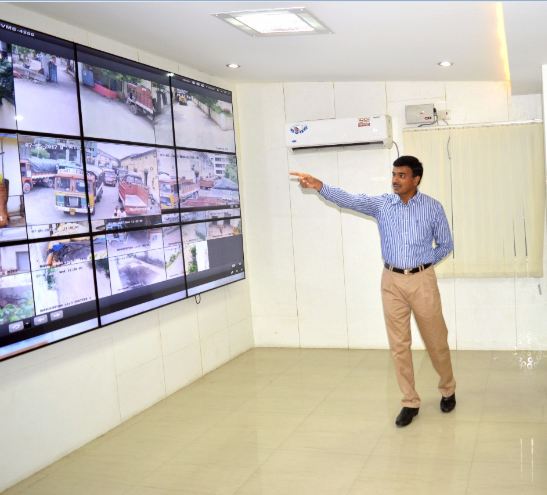 |
| Civil Supplies Commissioner C.V.Anand monitors godowns and transport vehicles |
The way civil supplies department went about busting the racket, and, in the process, shattering a myth that nothing could be done to change to system that allowed for pilferage of rice, is interesting. TOI checked out the mechanism put in place by CV Anand, commissioner of civil supplies and ex-officio principal secretary, civil supplies department. The IPS officer, who had previously serviced as Cyberabad police commissioner, used his exposure to technology to introduce it even in the civil supplies department.
“The revolution that has been brought about to check pilferage of food grains is mainly due to the technology that makes it possible,” Anand said. In the civil supplies bhavan at Somajiguda, a huge screen gives out real-time specific detail about movement of stocks. Every identified route on which the trucks are transporting food grains has been geo-fenced. That is to say if a truck were to move on any other road and even stopped, the buzzer in the civil supplies bhavan will ring, prompting the monitoring personnel to call up the driver.In the earlier system when no tabs were kept on vehicles, it gave enough scope for pilferage of food grains. Similarly, cameras have been fixed at all godowns. Live CCTV footage is monitored so that there no pilferage. Anand also demonstrated the mechanism at fair price shops that prevents any pilferage. A real-time stock availability and sale is monitored. Beneficiaries also get the right quantity as technology connects both the weighing scales and the e-pos machine handled by the FPS dealer.
The e-pos machine gets activated only with the thumb impression of the FPS dealer and the beneficiary. Technology also exposed the fact that rice millers had not returned the rice that had been handed over to them for milling. Another racket of keeping the gunny bags was also busted. “The best thing that has happened is that farmers get their minimum support price within just a couple of days and directly into their bank,” Anand said.
Mar 31, 2018
'Ration from Anywhere'in Telangana from tomorrow
Mar 30, 2018
Civil Supplies Dept prepares for Paddy purchase in Rabi season
Commissioner for Civil Supplies C.V. Anand said that all arrangements are been made for purchasing paddy from farmers in the coming Rabi season which starts from next month. He suggested officials to be very cautious in this matter as it is dealing with lakhs of farmers.
The Commissioner said all necessary actions to be taken to see that farmers should not face any difficulty in selling their paddy at Minimum Support Price.
Anand held a review meeting with Officials on Rabi Paddy Procurement at Civil Supplies Bhavan on Friday. A wall poster was released on this occasion to spread awareness among farmers on Minimum Support Price and Online transactions.
The Commissioner said that Civil Supplies Department initially decided to purchase 37 lakh metric ton paddy. In the months of April 12.74 LMT, May 18.20 LMT, June 5.46 LMT of paddy yield is expected. For this 3259 Paddy Purchase Centres (PPC’s) are been arranged, said Anand. IKP’s - 1081, PACS (Primary Agricultural Co-operative Societies) – 1987 and others - 191 will be maintained. He advised officials to arrange PPC’s in reachable distance to farmers. He directed officials to take necessary action in arranging additional purchase centres if required immediately.
Basic requirements like Humidity checking machines, Paddy cleaners, Winnowing Machines, Moisture Metres, Drinking Water, Toilets, etc., should be kept available at the centres.
Minimum Support Price should be compulsorily to be paid to farmers. MSP for Ordinary paddy is Rs. 1550, Grade ‘A’ paddy is Rs. 1590. Awareness in farmers should be made to get paddy to PPC’s according to the standards of Central government.
Joint Collectors should consult rice millers district wise and allotment of paddy be made according to the capacity of the mills.
Allotment should be made according to the capacity of the mill. Paddy allotment 32 MT mill be allotted 3000 MTs, 40 MT - 4000 MTs, 50 MT - 5000 MTs, 60 MT - 6000 MTs, more than 60 MT - 8000 MTs paddy will be allotted. In any condition not more than 8000 MTs paddy will be allotted to any mill. Commissioner ordered millers should submit Custom Milling Rice (CMR) before September 30. In any case if CMR is submitted after due date no milling charges will be paid. Millers who are black listed and booked under criminal case, 6A case from this year 1st January will not be allotted paddy.
The Commissioner ordered officials on paddy allotment to millers based on requisitions from District Rice Millers Association and guarantee from two millers who are financially strong. In any case if CMR is not submitted to government before due date it should be recovered from the two guarantee millers. If excess due is there then it should be collected from milling / transport charges paid to District Rice Millers Association.
Subscribe to:
Posts (Atom)